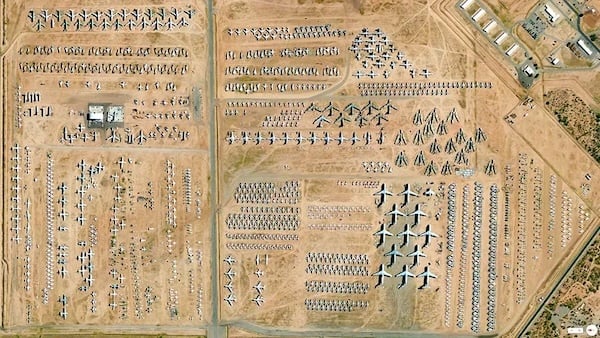
Row upon row of retired planes sit in the Arizona desert at the nation’s only military aircraft “boneyard.”

|
|
|
| “If the lion knew his own strength, hard were it for any man to rule him.” |
| |
|
Good morning, happy Monday! Here are today’s top stories. |
- Our reporter Allan Stein went to the Arizona desert to visit the world’s largest aircraft scrapyard, where row upon row of retired warplanes are preserved, used for parts, and sometimes rebuilt for a second life.
-
President Donald Trump rejected Iran’s response to the latest peace proposal pitched by the United States, calling it “totally unacceptable.”
-
Trump should return from his trip to Beijing this week with new agreements that benefit the United States, White House officials said.
-
The passengers and crew aboard the MV Hondius exited the hantavirus-stricken cruise ship in the Canary Islands. Acting CDC Director Dr. Jay Bhattacharya said the hantavirus outbreak “is not COVID,” suggesting that the virus, which normally spreads via rodents, won’t cause a pandemic. He added that CDC and U.S. health officials “don’t want to treat it like COVID.”
- 🍵 Health: Find the answers to the 10 most common Vitamin K shot questions.
|
|
|
The 309th Aerospace Maintenance and Regeneration Group at Davis-Monthan Air Force Base in Tucson, Ariz. Since 1964, the maintenance group has served as the sole designated storage, salvage, and disposal center for U.S. military and government organization aircraft. (Overviews created with Apple Maps, satellite imagery courtesy of Digital Globe) |
TUCSON, Ariz.—They are the dinosaurs of the modern age—hulking retired aircraft baking in the Arizona sun, stretching in rows across the desert. Once America’s defenders of the sky—B-52 Stratofortress and B-1B Lancer bombers, F-16 Fighting Falcon fighters, C-130 Hercules and C-5 Galaxy cargo planes—they now sit idle, preserved for parts or history. Maintaining and reclaiming these aircraft is no small task at the nation’s only military aircraft “boneyard.” At Davis–Monthan Air Force Base, the 309th Aerospace Maintenance and Regeneration Group (AMARG) oversees that work. “Most of these planes have been decommissioned, but the parts are still very useful. The parts are all viable,” public relations manager Robert Raine said during an April 21 tour of the 2,600-acre (4-square-mile) AMARG facility in Tucson. Each aircraft is secured for long-term storage, drained of fluids, stripped of explosive components, and preserved against the slow wear of the desert. Depending on the aircraft, some could be brought back into service, Raine said.
Since 1964, the maintenance group has served as the sole designated storage, salvage, and disposal center for U.S. military and government organization aircraft. The facility employs more than 700 workers and encompasses more than half a million square feet of industrial space.
Here, aircraft come to die, hibernate, or be reborn, their components cleaned, repaired, and repurposed for use in other machines—for conflicts now and those yet to come. The facility opened shortly after World War II, on April 1, 1946. The site was chosen for its dry desert climate and its ability to store vast quantities of surplus aircraft and military equipment.
Hard caliche soil, along with the absence of earthquakes and extreme weather such as tornadoes and hurricanes, made it an ideal place for long-term storage. The sprawling boneyard is home to 3,488 aircraft, ranging from supersonic fighter jets to massive refueling and cargo planes to strategic bombers—75 aircraft types and 6,700 engines in all. “AMARG is the last stop for parts” for legacy aircraft, Raine told The Epoch Times. However, it is “not an infinite source.” (More) |
- U.S. Ambassador to the United Nations Mike Waltz said Sunday that the United States will push the United Nations Security Council to pass a resolution condemning Iran’s attacks on international shipping in the Strait of Hormuz.
-
Tax noncompliance among federal employees and retirees has increased over recent years, partly because of the suspension of certain collection programs during the COVID-19 pandemic, according to a report from the Treasury Inspector General.
-
The USDA issued a final rule implementing the Whole Milk for Healthy Kids Act, signed into law in January, restoring whole and reduced-fat milk options in school meals.
-
The USPS reported a net loss of $2 billion for the second quarter of fiscal year 2026, which is $1.3 billion lower than the $3.3 billion net loss suffered in the same quarter in 2025.
|
| ADVERTISER'S NOTE: |

|
The Pre-IPO Company with a $250B Opportunity
As tech giants reshape how people work, a $250B+ workplace tech opportunity is up for grabs. With the help of partners like Meta, Qualcomm, and Samsung, Immersed is perfectly positioned to seize it.
Immersed combined the world’s most-used remote work AR/VR software ($127B by 2030), AR/VR hardware ($100B+ by 2026), and AI productivity tools ($36B) to create a productive, communal, and distraction-free virtual workspace. That’s why 1.5M+ professionals, including Fortune 500 teams, already use it.
Now, Immersed is preparing to scale mass production for its productivity-designed Visor headset. 75,000+ already waitlisted, representing $71M in projected first-year sales.
You have just days left: Invest in Immersed at $0.72/share by Thursday, May 14th.*
|
|
Locals stand at the impact site of a Russian drone in a residential neighborhood, amid Russia's attack on Ukraine, in Vyshneve, Ukraine, on April 3, 2026. (Thomas Peter/Reuters) |
- Russia and Ukraine accuse each other of violating a three-day ceasefire brokered by the United States.
-
The British Foreign Ministry has summoned the Chinese ambassador after a London court convicted two men, including a former British immigration officer, of spying for the Chinese communist regime.
-
As the U.S. military continues to blockade Iranian ports, Iran has increased railway shipments with China in an attempt to mitigate the blockade’s devastating impact on its economy.
-
China’s prolonged economic slowdown and worsening local government finances are increasingly affecting the country’s civil service. Reports from multiple regions show delayed salaries, shrinking bonuses, and growing dissatisfaction among grassroots officials.
|
- I Lived the Consequences of ‘Gender-Affirming Care’—by Prisha Mosley (Read)
-
The Farmer Is Still Necessary—by Mollie Engelhart (Read)
- No, AI Won’t Make Money Obsolete—by Peter C. Earle (Read)
|
Choke Canyon Reservoir in Choke Canyon State Park in Three Rivers, Texas, on May 7, 2026. Corpus Christi relies heavily on the reservoir for water supply, but prolonged drought has sharply reduced water levels and reserves. (Brandon Bell/Getty Images) |
📸 America in Photos: Los Angeles Subway Extension, Rebuilding Homes After Eaton Fire, and Epstein Files Archive Opens in New York (Look) 🧰 Self-help: Your Personal Cybersecurity Checklist: 10 Things to Do Before You Get Hacked (Read)
💸 Money: Over 60? These 4 Financial Moves Might Offer Your Best ‘Return’ on Investment (Read)
💛 Inspiration: The Greatest Logician Since Aristotle—and Why He Believed in Life After Death (Read)
🎵 Music: Mozart’s Adagio In C Minor (Listen)
(Sponsored) [3 Days Left] Pre-IPO stock up 4,000%: With 1.5M+ users, Immersed’s spatial computing platform is shaping the next AR/VR workspace revolution. They’re projecting 10X revenue growth from their next headset release. Invest in Immersed at $0.72/share by Thursday, 5/14.*
|
(Illustration by The Epoch Times, Shutterstock) |
When The Epoch Times published a story on the dramatic increase in parents refusing newborn vitamin K shots in March, readers had a comment deluge, including concerns about what is in the injection, what the real odds of a bleeding crisis are, and whether there’s a defensible explanation for babies to have low vitamin K.
Many parents, such as 37-year-old mother-of-three Courtney Jane Gackstetter, have to make decisions about vitamin K moments after giving birth. They often receive inadequate information in response to their questions.
Gackstetter told The Epoch Times she quickly said yes to a vitamin K injection for her son 12 years ago and regretted it later when she learned it contained an ingredient to which she’d had a history of severe allergies.
Information remains difficult to find, she said, and sometimes health care workers aren’t equipped with answers. The following are questions from Epoch Times readers, along with the most straightforward answers we could find. Mothers pass very little vitamin K to their babies through the placenta, resulting in low levels in all babies.
Vitamin K is produced by gut bacteria, but newborns haven’t yet developed the microbiome needed to produce it. Infants’ microbiomes are only beginning to build at birth.
The newborn microbiome undergoes several transitions in the first three years: initial colonization in the first several days of life, changes as the diet shifts to solid foods, and finally, resemblance to an adult gut microbiome around age 3. Of note, the type of delivery and feeding—breast versus formula—and whether a baby or mother has taken antibiotics, can also affect microbial development. (More)
|
|
|
Thanks for reading 🙏 Have a wonderful day! |
—Cathy He, Madalina Hubert, and Kenzi Li. |
|
|
Copyright © 2026 The Epoch Times, All rights reserved.
Our mailing address is: The Epoch Times, 129 West 29th Street, Fl 8, New York, NY 10001 | Contact Us
Our Morning Brief newsletter is one of the best ways to catch up with the news. Manage your email preferences here or unsubscribe from Morning Brief here.
*This is a paid advertisement for Immersed Regulation A+ offering. Please read the offering circular at https://invest.immersed.com/ |
|
|
|