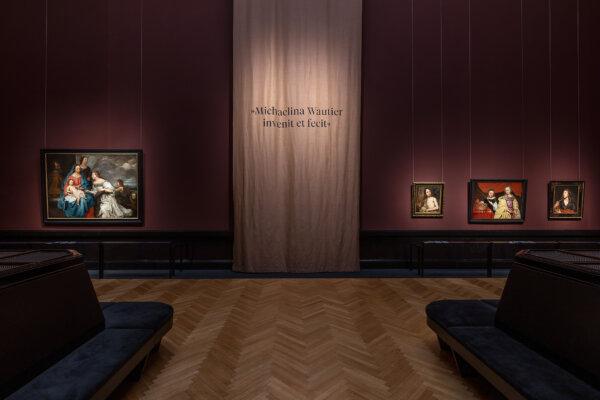
| For centuries, Michaelina Wautier's work were hidden in plain sight. Her paintings—confident, inventive, and technically masterful—were admired under other names, often attributed to her brother or to male contemporaries. Only in recent decades has scholarship begun to reconstruct her body of work and restore her reputation as one of the most remarkable painters of the 17th century. A major exhibition at Vienna’s Kunsthistorisches Museum is offering visitors that full view.
“Michaelina Wautier, Painter” gathers nearly every known work by the Flemish Baroque artist, offering a rare opportunity to see the full range of her achievement. Wautier worked fluently across genres—biblical scenes, mythological subjects, allegories, portraits, genre scenes, and floral paintings—often on a monumental scale. Her “Triumph of Bacchus,” a commanding celebration of classical mythology, stands as a bold declaration of artistic ambition.
Despite the scarcity of biographical records, the paintings themselves speak clearly. Wautier’s brushwork is assured, her compositions intellectually rich, and her engagement with antiquity unusually sophisticated. In her self-portrait, she presents herself with calm authority, tools in hand, meeting the viewer’s gaze. Elsewhere, she shows a gift for psychological insight, as in her portrait of Jesuit scholar Martino Martini, and for quiet symbolism, as in her vanitas scenes where childhood play becomes a meditation on time and mortality.
Highlights of the exhibition include the reunited series “The Five Senses,” rendered not with idealized figures but with lively, observant depictions of boys absorbed in everyday tasks. Even her rare still lifes break expectations, blending botanical precision with classical references.
Taken together, these works tell the story of an artist of rare independence and imagination. Long misattributed and overlooked, Michaelina Wautier now emerges as a central figure in European art history—finally recognized on her own terms.
|