
|
|
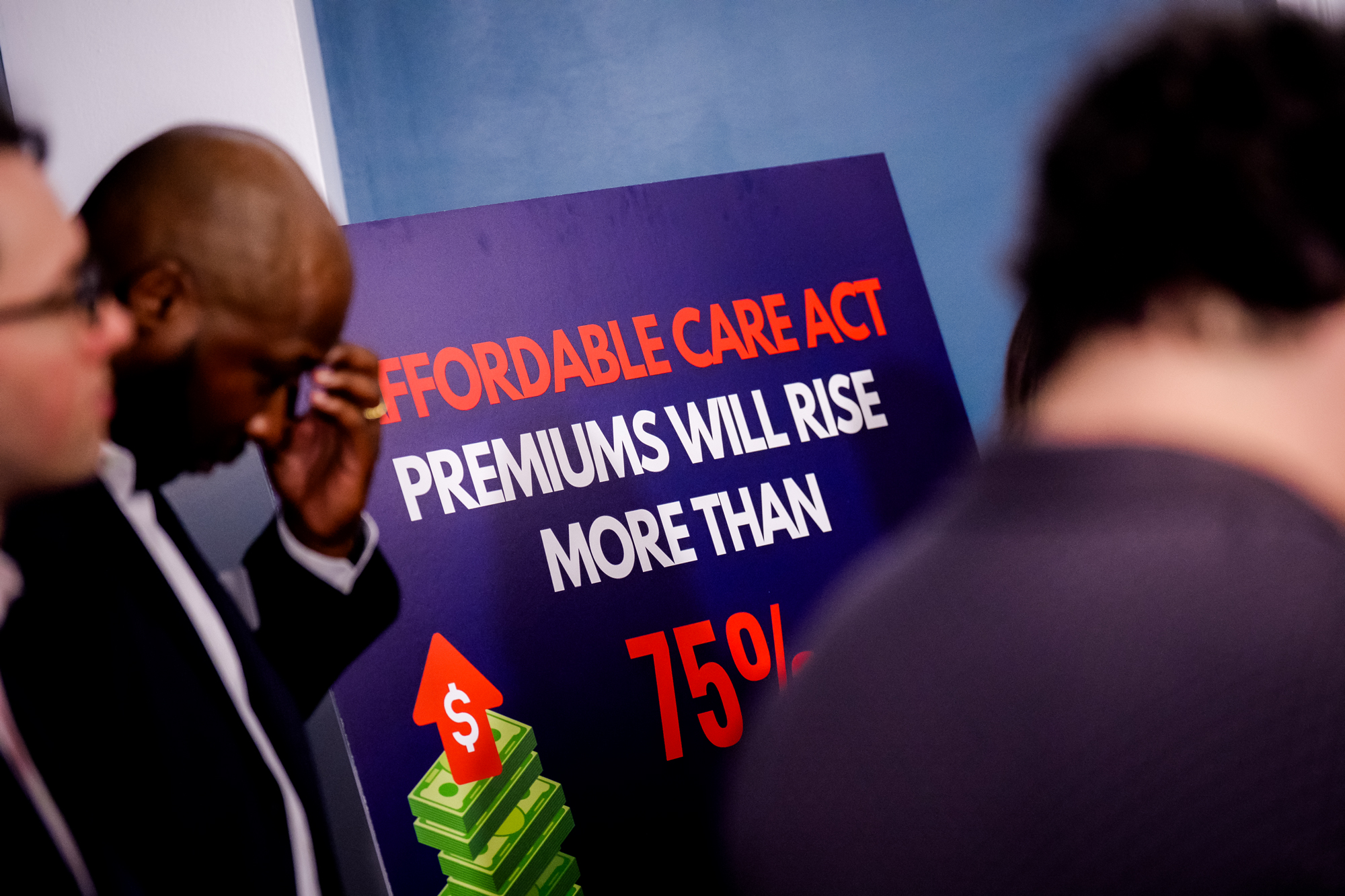
People stand next to a sign that reads “Affordable Care Act Premiums Will Rise More Than 75%” during a news conference on Capitol Hill in Washington, D.C., on Sept. 16, 2025. (Andrew Harnik/Getty Images) |
|
Small Steps Toward Medical Freedom |
|

|
By Jeffrey Tucker |
|
Commentary
Disaster beckons for millions of Americans on the Obamacare health-insurance system. Subsidies that began soon after its passage and have kept rising ever since are being allowed to expire. This will cause premiums to skyrocket as the real costs of this misnamed program (the Affordable Care Act) are revealed. Congress has so far been too tangled up in confusion to do anything decisive.
It’s likely that emergency funding will be deployed to patch up holes but this is not likely going to last. It is going to fall to Congress to do something to dramatically lower the costs of medical insurance in a way that will not bankrupt the system further. One side wants full nationalization with free coverage for everyone while the other side is still arguing about the best way to restore some semblance of economic rationality.
As a result, I’m going to present three urgent priorities for U.S. medical-insurance reform, plus two additional points that would be nice to have. My goal is to be as simple and clear as possible in hopes that even politicians can understand. If you can help get the word out, thank you. Sadly, this whole system has become so convoluted and the discussion so confused that certain obvious points need to be stated this way.
1. Permit a full range of catastrophic plans with premiums tied to individual risk and assessed by actuaries. Most people do not need more than catastrophic insurance. The co-pay system of endless streams of inexpensive visits, followed by high-deductible and very expensive specialty care, is simply not working. No one even understands how the pricing of this system works, so people both overuse it and underemploy it.
A true catastrophic plan must begin by explaining what a catastrophe is. It means injury from an auto wreck, a skiing accident, a sudden-onset cancer diagnosis, or a sudden and unexpected ailment that would result in financial devastation if it were paid out-of-pocket. There is not really a mystery here. We are talking hundreds of thousands of dollars.
This is how the system operated for half a century. Most Americans had this form of insurance. Otherwise, they paid cash for routine care. This is not complicated. We have a long history that shows how this works. In addition, in the old days, because most hospitals were nonprofit, they would frequently take in patients who did not have coverage.
In short, the system worked. What happened with Obamacare is that a group of intellectuals began to write a wishlist of coverage on a blackboard. They figured it was enough to make insurance companies pay for every ailment under the sun, even getting the blues in the winter or a sunburn in the summer. The actuaries were reassigned to assess risk and premiums on huge groups with defined benefits packages.
This change wiped out the main way Americans paid for medical care. Making a change to allow maximum freedom for catastrophic care would instantly drop premiums. By how much? I asked a number of AI engines to speculate. The typical answer came back at $100-$200 per month. That sounds reasonable to me.
Of course this means that the huge and sprawling services associated with “wellness checkups” and mental-health counselors and routine in-and-out doc services would have to be paid out-of-pocket. That is something that Americans can tolerate and would be thrilled to do so in exchange for not being pillaged for care that costs as much as 20-to-30 times as much now.
Yes, of course, many people on the receiving end of all this loot will try to stop this, but the change must be made. Average people will flood to the plans.
2. Permit anyone to have a health savings account (HSA)—not just the insured—with very high ceilings on contributions or no limit at all.
This crucial change will backstop the above change. This will allow Americans to save specifically for medical expenses and do so completely tax free. When the money is not being used, it can be invested in financial markets either safely or in risky portfolios, same as any other savings account.
Everyone knows about HSAs today but access to them is restricted to those who have existing insurance. This is for a reason. If access were broadened, millions would drop their coverage, thus crashing the system that demands maximum participation in order to hide the costs. That said, such a move would instantly reduce price pressure on the entire system, permitting a drop in premiums over time.
There is also the simple matter of freedom at stake. If people could control their own medical-care dollars, they will be more careful about how they spend them. Patients would start demanding quoted prices and even seek out cheaper alternatives. This would make providers competitive with each other, just like other businesses.
3. Untangle insurance from employment on a voluntary basis, so no more employer mandate and plenty of off-ramps for employees. Right now, businesses with over 50 employees have no choice but to provide insurance of some sort to employees. Those who do not are subject to outrageous penalties.
There is no reason for this system. Employment should be paid in wages and salaries, not teeth cleaning and mental-health counseling. This only happened due to wage controls in the Second World War. It was a way of getting around federal law. This was later nationalized. This whole system has to go but it can go on a voluntary basis.
Employers should be free to invite employees to leave the system in exchange for wages and salaries. They will take the deal, and be given a vast range of catastrophic plans they can buy and HSAs they can use. Millions will leave and this will fire up the commercial sector. Businesses that are throttled in their growth right now will immediately expand and increase hiring. This will lead to massive jobs creation.
Thus ends the top three most urgent priorities. These are the essentials. The changes need not take up a full treatise of a bill. It can be short. Any lawmaker who goes against this should be forced to say why, even if that means they have to reveal the special interests that are causing them not to do what is in the best interests of the American people.
This is the bare minimum required of any plan. It should be clean and simple.
There are two more points we should add.
4. All special liability exemptions for medical products and services must be ended. That includes vaccines on the childhood schedule. No business should ever be entitled to do any business without bearing consequences for harming others. No system of markets and freedom can possibly work this way. No more indemnifications for special interests. Period.
5. Allow and encourage performance-based payment systems vs. fee for service. Doctors, therapists, and hospitals should be allowed to price their systems this way, actually selling health results rather than selling drugs, diagnostics, and surgeries. This should apply to every form of medical services. For the first time, we would see incentives flip toward actually promoting health, which would mean pushing education and better living.
I could add another 30 or so points but the above would at least get the fundamentals correct. Doctors, patients, and insurers could take it from there, as a vast range of options would spring up everywhere.
Already, the market is burgeoning with options barely allowed under law: direct primary care providers, concierge providers, health-care coops, and medical tourism. With more permission, these would expand and the heavy hand of government and corporate cartels would be reduced.
The only possible means to get to this point will be public pressure. Congress certainly is not going to act on its own because their career status is too often based on serving special interests. But a rising demand for medical freedom among the people could make the difference. By year’s end, we could have an actual affordable care system in place. |
|
|
|

|
Jeffrey A. Tucker is the founder and president of the Brownstone Institute and the author of many thousands of articles in the scholarly and popular press, as well as 10 books in five languages, most recently “Liberty or Lockdown.” He is also the editor of “The Best of Ludwig von Mises.” He writes a daily column on economics for The Epoch Times and speaks widely on the topics of economics, technology, social philosophy, and culture. |
|

|
|
|
Thank you for being a subscriber
Your Feedback |