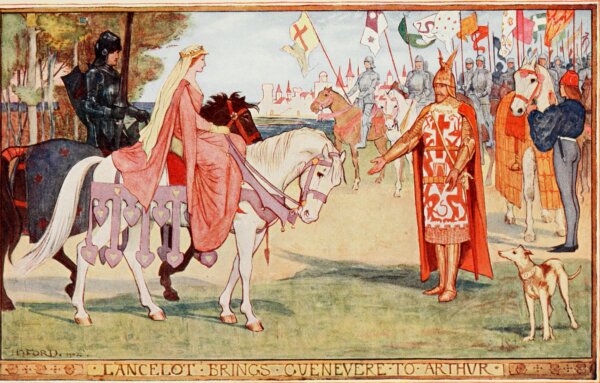
| In 1960, Alan Jay Lerner and Frederick Loewe’s “Camelot” took Broadway by storm. In that play, as Lancelot wends his way to King Arthur’s court, he sings of the attributes and virtues of a perfect knight: strength, courage, prowess in battle, and purity “with a will and a self-restraint that’s the envy of every saint.”
He asks, “But where in the world is there in the world a man so extraordinaire?” then boldly and humorously answers, “C’est moi!”
Broadway’s Lancelot embodies a code of chivalry conceived hundreds of years ago, a model of virtue, honor, and right conduct that has long served as a staple of Western manhood. Chivalric ideals influenced the social behavior of America’s Founders and helped define the Victorian gentleman. Even today, the knight haunts our postmodern sensibilities, a ghost in our algorithmic age who still has the power to summon boys and men to his banner.
To better understand the code of chivalry and its meaning for men, let’s look at one of the greatest knights of the Middle Ages, England’s William Marshal (c. 1146-1219), and the forces that shaped him.
Because he was a younger son, William had no hope of inheriting from his father, a minor noble. After a rough-and-tumble childhood amid upheavals in England, he was sent in his early teens to Normandy at the household of a relative for training as a knight. There, he excelled in horsemanship and the arts of individual combat while being schooled in the manners and courtesies of his class.
Knighted around age 20, William spent years fighting in battles and skirmishes, as well as in tournaments.
|