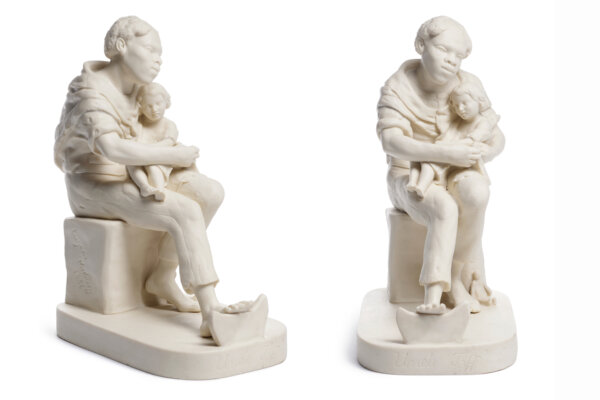
| Remarkable promise and tragic mystery surround artist Eugene Warburg. By his late 20s, the New Orleans–born artist had already established himself as a skilled neoclassical sculptor, working in marble, plaster, and porcelain. His career, however, was cut short, and only fragments of his work survive.
Born around 1825 in New Orleans to biracial parents, Warburg's early life was shaped by the antebellum South. Trained as a marble cutter, he contributed to projects such as the striking floors of St. Louis Cathedral before opening his own studio in the French Quarter. There, he began to build a reputation for refined craftsmanship and versatility.
Warburg traveled to Europe in 1852 in search of better opportunities. There, he experimented with parian porcelain, a material designed to replicate marble on a smaller scale. “Uncle Tiff” is one of his few surviving works from this period: a delicate sculpture of a black man cradling a white child, inspired by an abolitionist novel by Harriet Beecher Stowe. The piece reflects both his technical precision and interest in the social issues of his time.
Despite recognition and patronage abroad, much of Warburg’s work has been lost to time, fragile materials, or historical upheaval. His career ended almost as quickly as it had risen; he died in Rome in 1859 at the young age of 34. Perhaps this largely forgotten artist will be better recognized and more of his work recovered.
|