
|
|
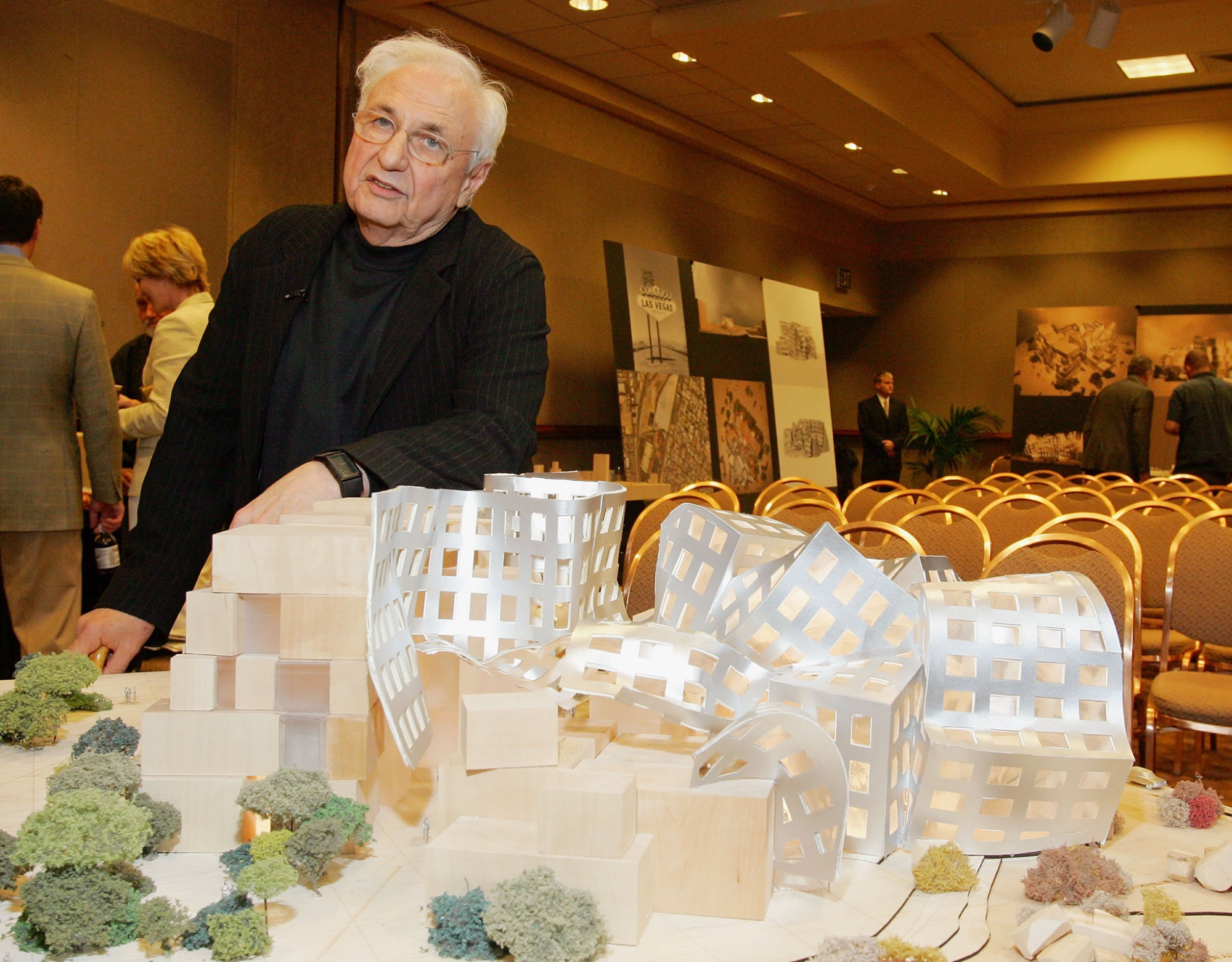
Architect Frank O. Gehry is interviewed about his design for the Lou Ruvo Alzheimer’s Institute after a news conference at the MGM Grand Conference Center in Las Vegas, Nev., on Feb. 11, 2006. (Ethan Miller/Getty Images) |
|
Time to End the Deconstruction |
|

|
By Jeffrey Tucker |
|
Commentary
Recently, the celebrated architect Frank O. Gehry died at the age of 96. The world press overflowed with hagiographic tributes to the great man, along with images of his buildings. They include Guggenheim Museum Bilbao (Bilbao, Spain), Walt Disney Concert Hall (Los Angeles, USA), Fondation Louis Vuitton (Paris, France), Dancing House (Prague, Czech Republic), Museum of Pop Culture (Seattle, USA), and many more, including his own residence.
Some of the buildings make a strong impression. Others are interesting. Others, not so much. There is little in these structures that is as magisterial, inspiring, or aspirational as the cathedrals of 800 years earlier or the beloved skyscrapers of even a century ago.
His mode of design was to make them disorienting, confusing, and seem almost uninvited as part of a common community of order and beauty. Despite all the performative cheers for his work, plenty of people would rather they not exist. It’s doubtful that they will stand the test of time.
True, few say this out loud. The buildings are notoriously hard to maintain. The exigencies of weather are brutal on them. They are nearly impossible to heat and cool in a stable manner. They behave in strange ways with the sun and its reflections, to the point that engineers had to make big changes after experiencing what it is like actually to use them.
In short, they are impractical. And they do not conform with anything consistent with traditional standards of beauty. If they lack traditional form or practical function, what is their point? Gehry’s buildings have been designed to show off the brilliance of an architect and his school of thought. I don’t know what else to conclude from this.
To be sure, his work is more humane and whimsical than the brutalist style and less overly angry than the many monstrosities constructed in the period following the Second World War by other celebrity architects.
Still, they are frustratingly puzzling and disorienting. For what purpose? This is always the burning question, not just regarding his work but also more generally about architecture of his generation, in addition to music, painting, interior design, and even fashion.
Isn’t it long past time to stop disorienting and start again to orient?
Maybe we should stop deconstructing and start again to construct. Stop dabbling in postmodernism and reembrace the wisdom of the ages. Cut it out with the overt statements of a lack of belief—nihilism as the prevailing philosophy of public life—and start again to believe in something meaningful.
This attitude that the past is always wrong and only intellectuals tuned to the future should be in charge has become tired and boring.
This entire mode of tearing up the pea patch—in every art and science—has been going on for longer than a century. Mostly the mode of artistic meltdown followed the horror of the Great War and the violence it inflicted on the human spirit. Intellectual movements in all fields lost track of what progress should look like and sound like. The one path forward seemed to be to take apart what has been and replace it with something else.
Let’s go back in time a bit to understand how this idea of the inevitability of progress became culturally entrenched. The late 19th century was the highwater mark of the Whig theory of history. Everything new is improved over what was. All prevailing wisdom in every field necessarily incorporates the best that came before with no lost knowledge along the way. Mankind is blessed with creative power to invent ever better things and ways of doing this.
The evidence of this was all around that generation: telephones, electricity, commercialized steel, flight, travel luxury, cities rising into the air, diseases cured, prosperity unfolding for all classes, the advance of munitions, and much more. It must have been an astonishing time to be alive. The lure of the ideology of progress was impossible to resist.
A foreshadowing of the coming disaster came with the wreck of the Titanic, which was about more than just one ship. It was the sinking of a dream, and actually an entire vision of how life was supposed to unfold. It was to smooth sailing with no icebergs that would send the best, brightest, and richest to their painful deaths. So the diplomatic stumbling that unleashed the Great War looks in retrospect to be a continuation of the same.
The bright outlook for the future did not survive the Great War, nor did the Whig theory of history. The war was murderous and traumatizing for an entire generation and a worldview too. The art and styles of Western culture adapted to incorporate demoralization and disorientation as a main theme. You could hear it in the academic music, see it in the architecture, observe it in the art, watch it in the fashions.
No longer was beauty at a premium. There was a prevailing sense that anything built could be destroyed, and that caused a near halt to the idea of making anything for the ages. Essentially you had an entire culture respond to this war the way a parent responds to the early death of a beloved child. It causes one to question everything.
Move forward another generation and we encounter a continuation of the war on a grander scale, with more conscription and mass death, this time inflicted with industrial purposes. As that calamity came to an end with the unleashing deliberate mass slaughter, the high ideals that had dominated the end of the previous century were largely vanquished. They were replaced by what eventually came to be deconstruction, which mutated into what is called postmodernism.
The major presumption behind all teaching in all fields—whether music, art, architecture, design, theology, or philosophy—was grave skepticism about all that had been previously known about God, beauty, community, family, and morality. This nihilism was instantiated in art and design. It seemed as if everything was up for grabs. The intellectuals would lead the way toward an aimless future that clearly rejected the past but had no clue about what kind of order or society would evolve in the absence of meaning.
For the average person, this meant the emergence of ugly as an institution, always with intellectuals on hand to explain why you should like it. You encounter it at the museum, as you walk through room after room with stuff that makes no sense. You see it in public statuary that looks as if it was rescued from an industrial landfill. It meant having your ears assaulted following the intermission at the symphony concert. It meant giant murals on public buildings with aggressive political messaging.
At every turn, there was some exalted critic there to explain to you and all that liking and appreciating this was mandatory for every intelligent person. I’ve seen this happen hundreds of times at concerts, when the orchestra finishes the last notes of some incomprehensible cacophony. People in the first 40 rows rise in wild applause for fear of being judged a philistine, while the back rows sit rolling their eyes in contempt. The latter is the only honest reaction.
We’ve been mostly intimated into going along as elites “deconstruct” beauty and order before our eyes, while replacing it with nothing of value. It’s been going on for decades if not longer than a century.
The trouble with this worldview is that it has nothing truly positive or lasting to offer humanity. Its main value is in its tearing down of what was and reinterpretations of all settled ideas. The trouble is that tearing up the peapatch, while it might be fun and even thrilling, is an activity with a term limit. At some point, there is nothing left to destroy.
There is evidence that this entire ethos is coming to an end.
When Donald Trump proposed his new White House ballroom, there was never any question concerning its cultural import: it would be rooted in tradition and be gilded as if the Great War had never happened. That key point, much more than its footprint and funding, is the real sore point for many elite observers.
When the Cathedral of Notre Dame burned in 2019, the postmodernists licked their chops at the improvements they would make but they were shouted down; the final results are gloriously deferential to the past. So it should have been and must be.
Those are two of countless examples. Postmodern deconstructionism was always a dead end. We hit it decades ago, and every honest observer knows it. You can only destroy for so long before there is nothing remaining to do. At some point, there had to be a turn in this ethos but a turn toward what? There is only one answer: the past, the very period of idealism that prevailed before war and economic crisis shattered our belief in meaning.
The pages of fashionable publications are packed now with reluctant homages to the greatness of this or that postmodernist architect or painter who has died. That’s fine: no need to speak ill at such times. But there has never been a better time to admit that it was all an egregious error. Now is the time to reembrace—with no hint of irony—what it means to build rather than tear down civilization. |
|
|
|

|
Jeffrey A. Tucker is the founder and president of the Brownstone Institute and the author of many thousands of articles in the scholarly and popular press, as well as 10 books in five languages, most recently “Liberty or Lockdown.” He is also the editor of “The Best of Ludwig von Mises.” He writes a daily column on economics for The Epoch Times and speaks widely on the topics of economics, technology, social philosophy, and culture. |
|

|
|
|
Thank you for being a subscriber
Your Feedback |