Health Secretary Robert F. Kennedy Jr. answered questions from senators for the first time since the firing of the CDC director. Here are five takeaways from the hearing.

|
|
|
| “To love truth for truth's sake is the principal part of human perfection in this world, and the seed-plot of all other virtues.” |
| |
|
-
Health Secretary Robert F. Kennedy Jr. answered questions from senators for the first time since the firing of the CDC director. Here are five takeaways from the hearing.
-
President Donald Trump will sign an executive order on Friday, renaming the Department of Defense to its previous title, the Department of War.
-
Do doctors make money off vaccines? Here’s a look at the incentives and bonus structures.
-
A growing number of people across the globe are walking away from organized religion, yet many of them still embrace ideas of an unseen spiritual realm, life after death, or divine powers, a new study suggests.
-
Interview: Dr. Robert Malone: What’s Really Happening at the CDC? (Watch)
|
☀️ Good morning! It’s Friday. Thank you for reading the Morning Brief, an exclusive newsletter for Epoch Times subscribers. 👋 New to Morning Brief? Subscribe. 🎧 Prefer to listen? Get the podcast. |
|
|
| Ivan Pentchoukov
National Editor |
|
|
An aerial view of the Pentagon in Arlington, Va., on April 2, 2025. (Madalina Vasiliu/The Epoch Times) |
President Donald Trump will sign an executive order on Friday, renaming the Department of Defense to its previous title, the Department of War. White House press secretary Karoline Leavitt confirmed the announcement on X. “Trump to rename Pentagon, restoring historic ‘Department of War’ in latest military move,” she wrote on Sept. 4.
The president had proposed returning to the Department of Defense’s original name while signing executive orders in the Oval Office on Aug. 25.
“Pete, you started off by saying ’the Department of Defense.' And somehow it didn’t sound good to me,” Trump said, speaking to Secretary of Defense Pete Hegseth.
“Defense. What are we, defense? Why are we defense? It used to be called the Department of War, and it had a stronger sound. And, as you know, we won World War I, we won World War II, we won everything. Now we have a Department of Defense. We’re defenders. I don’t know.”
Trump had also floated the name change while speaking with reporters at the NATO Summit on June 25. “You know, it used to be called Secretary of War,” Trump said. “Maybe for a couple of weeks we’ll call it that because we feel like warriors.” At the same event, the president introduced Hegseth as “secretary of war,” and suggested that the change to the current “secretary of defense” was because “we became politically correct.”
Hegseth had also called for changing back to the “Department of War” title prior to being named Trump’s Secretary of Defense.
“Sure, our military defends us. And in a perfect world it exists to deter threats and preserve peace,” he wrote in his 2024 memoir, “The War on Warriors—Behind the Betrayal of the Men Who Keep Us Free.”
“But ultimately its job is to conduct war. We either win or lose wars. And we have warriors, not ‘defenders.’ Bringing back the War Department may remind a few people in Washington, D.C., what the military is supposed to do, and do well.” (More) More Politics: |
- A bipartisan group of House members has introduced a bill to extend certain tax credits for Obamacare enrollees, which are set to expire at the end of the year.
-
President Donald Trump asked the Supreme Court on Sept. 4 to let him fire Federal Trade Commission (FTC) member Rebecca Slaughter after a federal appeals court reinstated her two days before.
-
FBI agents retrieved documents, iPhones, USB drives, and other devices during a search of former White House national security adviser John Bolton’s home last month, according to newly released court papers.
|
The U.S. trade deficit widened sharply in July, climbing by more than 30 percent as imports of capital goods surged to record levels, signaling resilient domestic demand and firmer business investment.
The overall gap in goods and services rose by 32.5 percent to $78.3 billion, the Commerce Department reported on Sept. 4. Imports increased by 5.9 percent to $358.8 billion, while exports edged up just 0.3 percent to $280.5 billion, leaving the goods deficit 21 percent higher than in June at $103.9 billion.
Cutting trade deficits has been a central goal of President Donald Trump’s policy agenda, alongside a push to reindustrialize the U.S. economy. While the July trade deficit figures undercut the first objective, the details suggest a lift for manufacturing.
Capital goods imports climbed by $4.7 billion to a record $96.2 billion, driven by inflows of computers, telecom gear, and industrial machinery. Industrial supplies and materials rose by $12.5 billion, including a $9.6 billion increase in nonmonetary gold. Economists note these categories are closely tied to business investment, as they represent tools, equipment, and raw materials used to expand production capacity. “The higher import number reflects increased business demand for capital investment. CapEx expenditures are projected to increase significantly this year as far as investments in both infrastructure and technology,” Dan Varroney, president and CEO of Potomac Core, a consulting firm specializing in trade matters, told The Epoch Times in an emailed statement.
“President Trump’s new Big Beautiful Law, for example, is designed to get businesses to invest on the front end. The 100 percent expensing provision is a boon for manufacturers. It is an accelerant for small businesses in the manufacturing arena, and we can expect to see strong investment in this sector.” (More)
More U.S. News: |
-
Nasdaq proposed rule changes aimed at combating pump-and-dump schemes that law enforcement warns have seen a 300 percent increase this year.
-
Law enforcement agencies in the United States announced the largest seizure of chemical fentanyl precursors in U.S. history, at a Sept. 3 news conference in Houston.
-
Three Americans, 22 Chinese nationals, and four Chinese companies have been indicted on trafficking charges for allegedly facilitating the flow of illicit cutting agents from China that are mixed with fentanyl, federal officials announced on Sept. 3.
-
The City of Seattle regained full control of its police department after a federal judge granted a motion to end the consent decree from the U.S. Department of Justice that has been in place for 13 years.
|
| Advertiser’s Note: |

|
|
A growing number of people across the globe are walking away from organized religion, yet many of them still embrace ideas of an unseen spiritual realm, life after death, or divine powers, a new study suggests.
Pew Research Center on Thursday published its findings on so-called “religious nones,” a category that covers atheists, agnostics, and those who describe their religion as “nothing in particular.” Drawing from surveys conducted in 36 countries, Pew highlighted results from 22 of them, where the unaffiliated made up a large enough sample for separate analysis. In every one of those 22 nations—including the United States, Canada, and Mexico—at least 19 percent of unaffiliated adults said they believe in an afterlife, Pew said.
The share was much higher in the Americas: 65 percent in Peru, 53 percent in Brazil, and 50 percent in the United States. Even in more secular European societies like Sweden and once-communist Hungary, about one in five “nones” held that belief.
Many also reported belief in a spiritual dimension beyond the physical world. Majorities in Brazil (65 percent) and Mexico (61 percent) agreed with the statement that “there is something spiritual beyond the natural world, even if we cannot see it.”
Belief in ancestral spirits was also widespread. Across most of the countries surveyed, between 20 and 40 percent of unaffiliated adults said the spirits of ancestors can help or harm the living—including 36 percent in France, 31 percent in Canada, and 25 percent in South Korea. In South Africa, an overwhelming majority (81 percent) of “nones” affirmed that belief. (More)
More World News: |
-
President Donald Trump signed an executive order on Sept. 4 to impose new 15 percent tariffs on Japanese goods and enact other provisions of a previous trade agreement with Tokyo, which includes $550 billion in commitments from Japan to invest in the United States.
-
The United Arab Emirates said that annexation of the West Bank would be a red line for Abu Dhabi and would seriously undermine the spirit of the Abraham Accords, which established full diplomatic relations with Israel.
-
The hot mic moment during which China’s and Russia’s leaders were musing about increased longevity through organ transplants speaks to more than their mutual desire to stay in power. Rep. Chris Smith (R-N.J.), a lawmaker who monitors human rights abuses abroad, said that the off-the-cuff exchange—and the casual way organ transplants came up—was unsettling. “It shows how cruelty knows no bounds,” Smith told The Epoch Times.
|
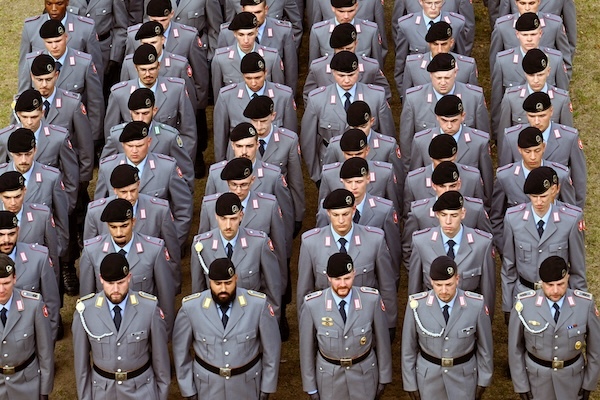
Recruits of the German Armed Forces Bundeswehr are sworn in on Sept. 4, 2025 in front of North Rhine-Westphalia's state parliament in Duesseldorf, Germany. (Ina Fassbender/AFP via Getty Images) |
📸 Day in Photos: Indonesian Protester Killed, Drought in Iraq, and Grape Harvest (Look) ✍️ Opinion |
-
3 Uncomfortable Truths About School Shootings—by Amy Swearer (Read)
- How Education Fraud Is Crippling America—by Newt Gingrich (Read)
-
Free the Enslaved Food System—by Mollie Engelhart (Read)
- The Case for Nationalism—by Jeffrey A. Tucker (Read)
|
🎵 Music: Mozart - Serenade (Listen)
(Sponsored) Special Offer: Don’t wait for the government to fix the economy. Precious metals have been trusted for generations. Request your FREE Info Kit now and discover how gold and silver could help secure your wealth. Get up to 10% in Bonus Silver today! |
(Illustration by The Epoch Times, Shutterstock) |
Lyme disease affects approximately 476,000 people each year in the United States, making it one of the most significant tick-borne illnesses of our time. Named after Lyme, Connecticut, where it was first identified in 1975, this complex condition often masquerades as other illnesses, leading to delayed diagnosis and treatment.
Unlike many infectious diseases, Lyme disease doesn’t follow a predictable pattern. It progresses through stages that present different symptoms, which may overlap or appear unexpectedly. Awareness of early signs and prompt treatment is crucial.
Lyme disease occurs when the bacterium Borrelia burgdorferi enters the bloodstream through the bite of an infected blacklegged tick. The eastern blacklegged tick, or deer tick, causes most U.S. cases of Lyme disease, while the western blacklegged tick accounts for far fewer.
The bacteria live naturally in white-footed mice, which serve as the primary reservoir. When tick larvae or nymphs feed on these infected mice, they pick up the bacteria. As these ticks mature and seek their next blood meal, they may transmit the infection to humans.
Ticks must remain attached for 36 to 48 hours to pass along the bacteria. The delay occurs because the bacteria must move from the tick’s gut to its salivary glands before transmission.
Lyme disease does not spread from person to person. While dogs and cats can contract Lyme disease, they cannot transmit it directly to humans. Mother-to-fetus transmission during pregnancy is also rare.
Not all ticks carry Borrelia burgdorferi, however, and infection rates vary by region—from less than 1 percent in low-risk areas to over 50 percent in regions where Lyme disease is common. Even when a tick is infected, the chance of transmission depends on how long it remains attached. (More)
|
|
|
Thanks for reading 🙏 Have a wonderful day! |
—Ivan Pentchoukov, Madalina Hubert, and Kenzi Li. |
|
|
Copyright © 2025 The Epoch Times, All rights reserved.
Our mailing address is: The Epoch Times. 229 W. 28 St. Fl. 7 New York, NY 10001 | Contact Us
Our Morning Brief newsletter is one of the best ways to receive the most up-to-date information. Manage your email preferences here or unsubscribe from Morning Brief here.
|
|
|
|