|
|
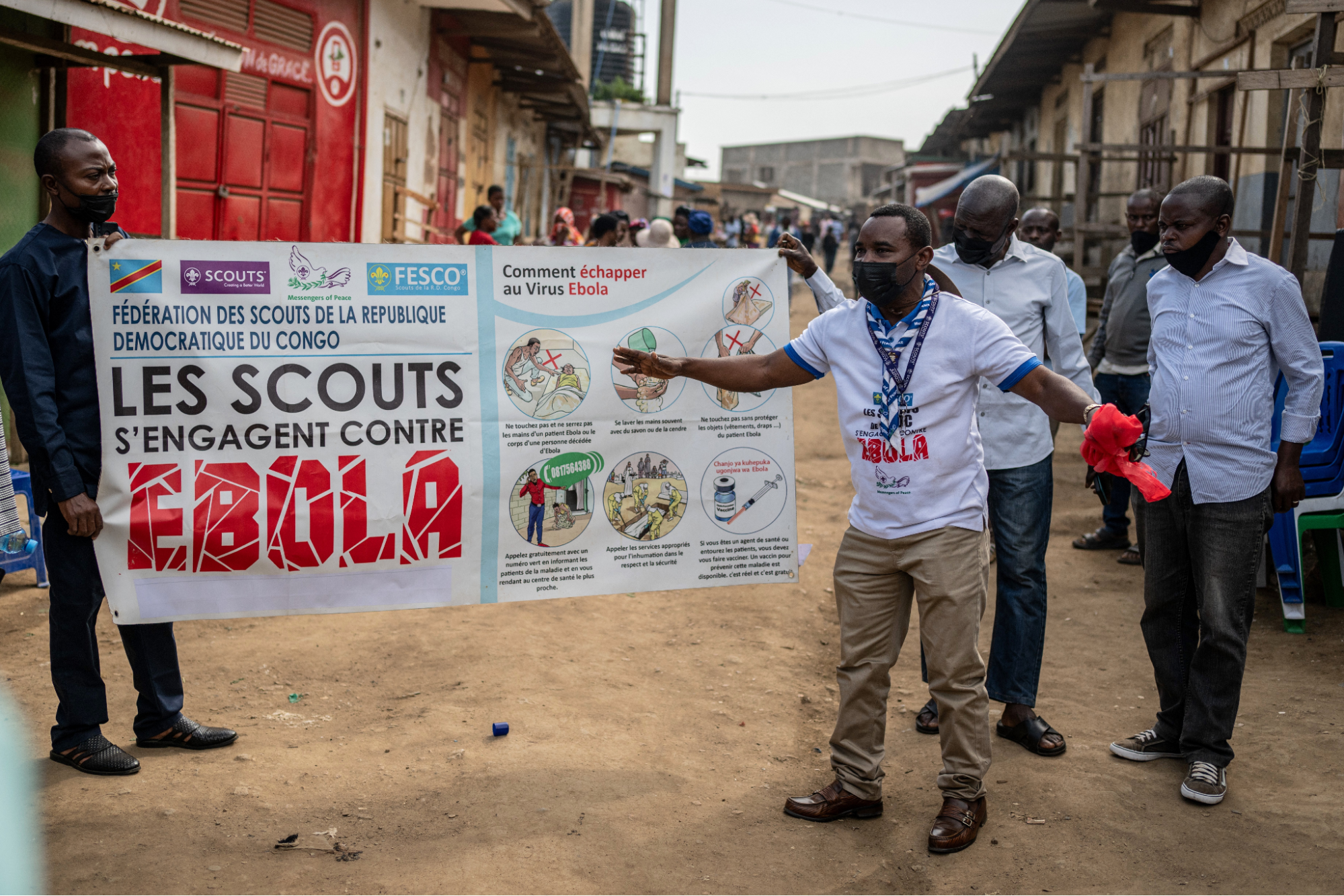
Members of the Congo Scouts movement carry an Ebola awareness banner along a street during a public sensitisation campaign amid the Ebola outbreak in Bunia, Congo, on May 23, 2026. (AP Photo/Moses Sawasawa) |
|
Viruses for Dummies |
|

|
By Jeffrey Tucker |
|
Commentary
Over this past week, we’ve been subjected to a flurry of pandemic warnings. It’s like the disease of the day: Bird flu, novavirus, m-pox, hantavirus, slap rash (did you miss that one?), and Ebola. A former director of the CDC just warned that this Ebola outbreak could become a pandemic.
It sounds scary but that is literally impossible for reasons I will explain. My hope is that this article will allow you to know this too. My point is to rescue basic knowledge of infectious disease that every person knew in my grandmother’s generation. The postwar period put huge emphasis on this in schooling. It was called public health in those days.
They knew much more than certified experts today.
To be sure, my training is in economics, not virology, not immunology, and not epidemiology. That makes me the ideal teller of the way to understand pathogens. Why? Because this is a subject about which I knew little six years ago but COVID caused me to dive deep into the literature and speed learn.
Shockingly, I now find that I know more than many supposed experts. Why would that be the case? Every profession these days, whether economics or epidemiology, is subject to epistemic capture. They have all created bubbles for themselves that are shaped by industrial forces. To really understand the topic in question often requires a complete outsider.
I’m going to break it down to three principles. If you stick with me, you will carry away a decoder ring to see through every media frenzy about infectious disease.
One, a milder exposure to a pathogen generates broad and lasting immunity against a stronger exposure. This of course is the principle behind vaccination but, as even Fauci once explained, there is no better immunity than that obtained by natural exposure. This principle has been known for thousands of years, documented even in Thucydides’s “History of the Peloponnesian War.”
I learned it as a kid when I was exposed to chicken pox and gained lifetime immunity. Before the shot came along, exposure of the young kids gave a booster to adults to protect them against shingles.
This is why George Washington did not accept a smallpox variolation (earlier form of vaccination) even as the army under him often did: he had it as a young man. This is the reason the legendary milkmaids of centuries past had clear skin: exposure to cowpox insulated against smallpox. It’s why workers in chicken factories are more immune to Bird flu. It’s why kids should not be cocooned in germ-free environments, contrary to the fashion these days.
It’s why there was so much death in the 1918 flu pandemic. Vast numbers of people due to war and travels were unexposed to the pathogen in question. Several flu seasons prior had gone by with low virulence and exposure. Returning soldiers confronted an immunologically naive population.
It’s always dangerous to disturb natural exposure patterns within the social order. After a year of lockdowns, it’s not a surprise that the population was more vulnerable to sickness than ever before. Hiding from widespread and mutating pathogens only makes one more vulnerable later. No population cell is more sickly than one that has been isolated from exposure, as centuries of experience show.
Two, with most pathogens, there is a negative correlation (an inverse relationship) between severity and prevalence. When one is up, the other is down. Severity refers to its virulence, its tendency to render cases, hospitalization, and death. It is measured by the case fatality rate or CFR. A pathogen does not arrive with a built-in CFR, like some computer algorithm. It depends on the level of population immunity (see above).
The CFR is different from the infection fatality rate (IFR), which indicates prevalence; that is, how much and how far a pathogenic infection spreads. Infections can be mild. They can even be without symptoms. The IFR can be very high while the CFR is very low. Indeed that is most often true. A high IFR means that a pathogen is not killing its host. A high CFR means that it is not likely spreading quickly and broadly.
Already I knew something was fishy in the COVID-19 period when mass media conflated cases, infections, and exposures. All the charts we saw on “cases” were not really that; they were positive tests using a technology designed only to capture the presence of the virus, not its medical significance. It was all wildly misleading.
COVID-19 had a very low IFR but a medium-level severity. That is because it was and is an intelligent pathogen. Viruses with unimpressive performance kill their host quickly and thereby do not spread.
Ebola is the classic case. Killing one’s host is not the most desirable outcome for a virus. “In ecological terms,” writes Sunetra Gupta, “it constitutes a form of habitat destruction. When they kill their hosts, pathogens also kill themselves, and this is a disaster unless their progeny have already spread to another host.”
Clever viruses like COVID minimize severity and so they can spread more broadly through the population—the common cold would be a good example. “By being less destructive, a bug may also enhance its chances of transmission,” she explains.
Three, the tradeoff between severity and prevalence is subject to a condition called latency. This is the period of time in which the infected person experiences no symptoms and can thus spread the disease. With a typical cold or flu, that period is a few days during which you are infectious and do not know it. Your symptoms will last a few days beyond which you can infect others.
There are viruses that have long periods of latency, among them the one said to cause AIDS. That is why it was so deadly among the vulnerable population. Other peculiar viruses like the hantavirus spread from rats, but typically not between people, and have a long period of latency. It can take eight weeks for symptoms to manifest. It also tends to be true that the longer the latency, the more difficult it is for a virus to spread with casual contact.
When COVID-19 hit, it was the theory of Deborah Birx that SARS-CoV-2 had a two-week latency, which is why she claimed there was silent spread. As it turns out, she was wrong: the latency period is that which is more typical among coronaviruses, a few days.
Nearly all movies about pandemics have to game this point for dramatic purposes. There is invariably some deadly pathogen circulating that suddenly seizes a person who drops dead. Then others with whom that person had casual contact over the prior month start dropping dead. Then dead people are everywhere.
This is all fiction. So far as we have records, there has never been a pathogen that is very severe, very widespread, mutates fast, and carries an extended latency period of months. This is not an accident. It is a biological necessity. It is how we as human beings co-evolved with the microbial kingdom of which we are part.
We have survived because we have adapted alongside and as part of the microbial kingdom. It is not the enemy but essential to our survival. Every movie that posits some other scenario is making stuff up.
And by the way, this is even true of lab-created viruses like that which created COVID-19. It can be nasty, uncomfortable, frustrating, even scary. But even lab-created viruses adapt to the natural world, as we have seen. Alpha became Delta which became Omicron and eventually merged into being part of the seasonable landscape of our lives. This is why every pandemic burns itself out. It’s a consequence of immunity born of exposure combined with mutations.
The best way to understand mutations and variants is by analogy to wardrobes of clothing and disguises. Some pathogens come with a vast collection. Malaria is an example. It is always mutating and changing, and so it becomes extremely difficult to chase down and finally to destroy with a vaccine. For many decades scientists assumed that they could get it under control but it was not to be.
It is also true for flu viruses, which have a different garb for every season. This is why the flu shot is not particularly effective and sometimes negative in its efficacy. An example of a virus with an unimpressive wardrobe is measles. It has only one uniform so it was possible to identify and finally to manage to near perfection with a vaccine. That is not to say that the vaccine is superior to natural infection—one infection creates lifetime immunity—because every pharmaceutical has downsides, often unanticipated ones.
As for the others with wide adaptability, there is no way against which they can be vaccinated, even in theory. Many people have tried for countless decades. It is simply not possible for very specific epidemiological reasons. Anyone who says otherwise is a charlatan, now and always. Period. Learn that lesson and spare yourself grief.
How likely is it that we will experience a deadly pathogen that wipes out large swaths of humanity through uncontrolled spread in a manner in which our bodies are unable to withstand? The chances are near zero.
Let’s game this out with these observations:
Measles: severity low, prevalence high, latency short, mutability low
Flu: severity low, prevalence high, latency short, mutability high
Ebola: severity high, prevalence low, latency short, mutability medium-high
Hantavirus: severity high, prevalence low, latency long, mutability low
COVID: severity medium-low, prevalence high, latency short, mutability high
Rabies: severity extremely high, prevalence extremely low, latency short, mutability low
Norovirus: severity very low, prevalence high, latency short, mutability high
Malaria: severity high, prevalence high, latency short, mutability high
Notice among all those listed, only one seems to evade the mathematical logic of viruses; that is malaria. It is a wicked killer, beyond 600,000 people a year but also not really a virus. It is a parasite with a particular vector of invasion via mosquitos, which is why it is not a pandemic risk but rather a regional risk. For that reason, it does not belong on the list.
See how there is a logic to all this?
Why is it important that everyone—I mean everyone—have a basic understanding of the above? To bring not panic about pathogens but rather a calming wisdom. We evolved alongside pathogens. We understand them better than ever before. Our life experiences have granted us remarkable resilience. We should not be endlessly buffeted by the media winds of frenzy designed to elicit likes and clicks.
Why in the 21st century so many people have chosen to forget what we learned over the course of the 20th century is a true mystery. I hope this article helps trigger some knowledge gain. |
|
|
|

|
Jeffrey A. Tucker is the founder and president of the Brownstone Institute and the author of many thousands of articles in the scholarly and popular press, as well as 10 books in five languages, most recently “Liberty or Lockdown.” He is also the editor of “The Best of Ludwig von Mises.” He writes a daily column on economics for The Epoch Times and speaks widely on the topics of economics, technology, social philosophy, and culture. |
|
|
|
|
Thank you for being a subscriber
Your Feedback |