
|
|
(Gregory Walton/AFP via Getty Images) |
|
Why Do Large Companies Keep Doing This? |
|

|
By Jeffrey Tucker |
|
Commentary
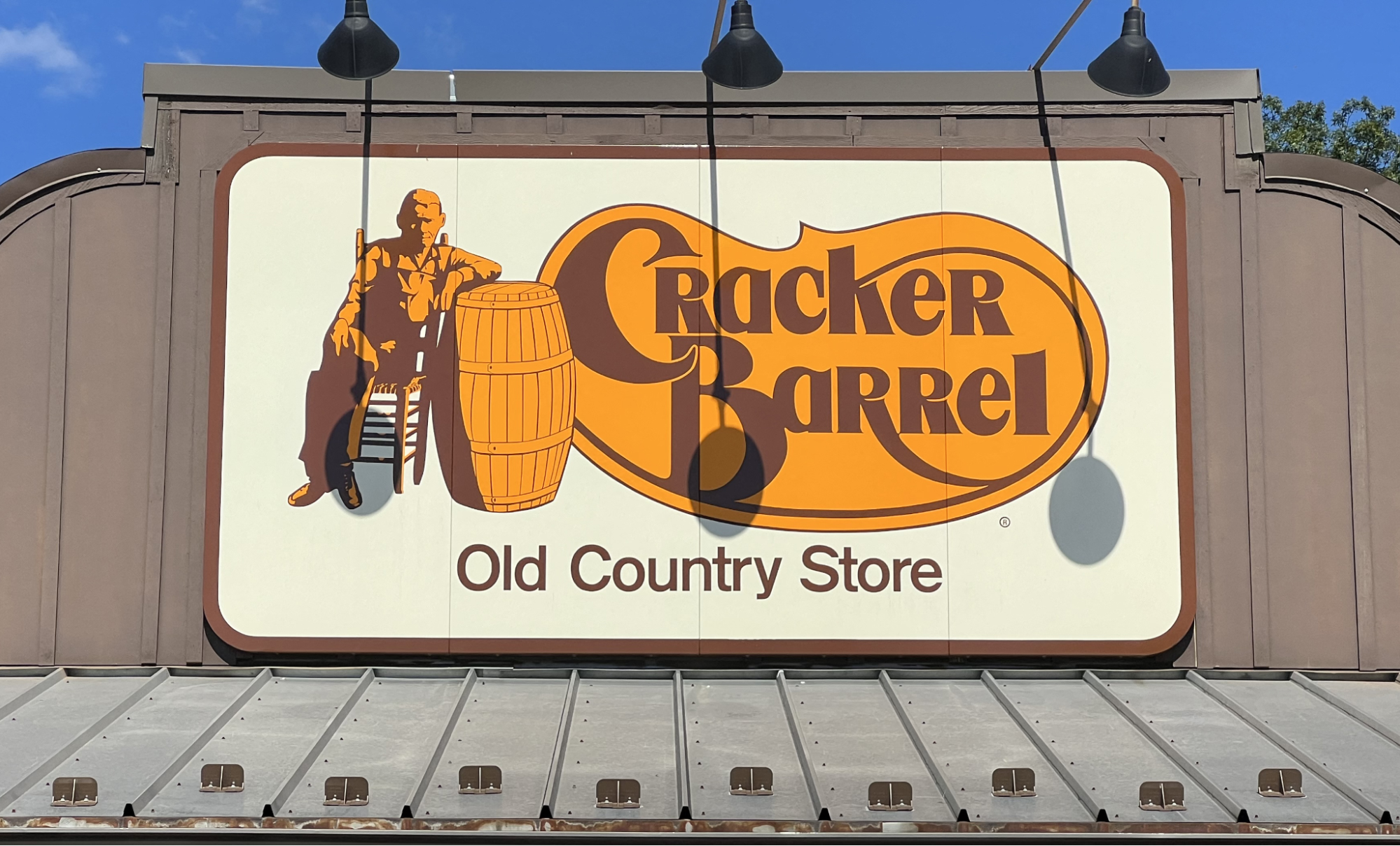
A once-beloved American restaurant has again been subjected to a redesign that upends its tradition. This has upset its loyal customers who held onto the place as a port in the storm, one representing family, tradition, and American history.
Cracker Barrel was founded in 1969 to keep alive the old-time country feel and its food. It settled on a logo featuring a mythical “Uncle Herschel” sitting on a rocking chair next to a barrel. The barrel is one that once held crackers in country stores but of course it is a double entendre: cracker is also a street term for a white person.
The woke obsession with race clearly led to a deprecation of the logo and its replacement with an aesthetic that is barren, soulless, and dystopian: just the essential words with nothing more. This brutal deracination is matched with a major remodeling push to remove the old tools, products, and old-timey feel from the restaurants, replacing the revanchist melange with an imagined future that looks like a hospital waiting room.
The financial markets were not impressed. In the past 30 days, during which time the website was changed and CEO Julie Felss Masino was all over the media saying how great are the unfolding changes, the traditional logo stripped away the man and his barrel. The company’s stock was slammed down 20 percent. Anecdotal reports suggest empty parking lots.
During the same period, the stock of American Eagle and its now-famous ads featuring Sydney Sweeney soared 26 percent. Go woke, go broke; go tradition, get rich.
Mostly I feel awful for the employees and customers of Cracker Barrel, who never asked for any of this. The people who make the food, serve, and keep the place clean are among the hardest working and lowest-paid workers there are. I worked in such restaurants and I know: it is a tough job. Having an upper-tier of management and marketing that knows nothing about the goings-on in the restaurants is demoralizing.
This fiasco follows other rebranding efforts that have similarly harmed companies. We need only to think about Jaguar’s disastrous abandonment of its logo and history, alongside the carnage that resulted from Bud Light’s attempt to court the trans buyers by sending a can to a fake-woman influencer with a large and gawking Instagram audience. Both efforts wrecked the companies.
The burning question to me is the following: Why do these capitalist companies persist in doing anti-capitalist things? Why do they insult their customers and betray their own histories in ways that end up devastating profits? I’ve settled on a combination of five possible factors toward an explanation.
1. Management Bubble
The CEO of Cracker Barrel shares biographical features in common with the head of marketing of Bud Light. She graduated from an Ivy League university and then did a Masters degree at a business school. She went straight from there to management at Sprinkles Cupcakes, Starbucks, and Taco Bell. There is no evidence that she actually ever worked in restaurants or knows anything about them beyond sitting on a perch of power. Now she pulls in $6.8 million a year.
The business education in these schools is all about leaving the past behind, adopting a new way of thinking and speaking, and figuring out ways to eliminate reactionary signaling from ads and signage. In class, they look at and study old ads and sniff in disdain from the bad old ways and develop a mission to reconstitute the human experience itself. In other words, they cultivate and internalize a panoply of hatreds and a burning passion to experiment on people.
They all came of age in a time when the profits flowed and flowed. They all took credit for it, confusing their woke ideology with some kind of causal link to success, all while carefully sealing themselves off from connection to common people. At their clubs and cocktail parties, they cultivated a careful taste for those whom they socialized and those with whom they did not.
Their skill was in hiding their elite outlooks from the people who they despised as workers, peasants, and useless biscuit eaters. None of these decision-makers had any stake in the history of these companies. Indeed, within their management structures, they brandished that absence of hands-on experience as a credential that allowed them to think outside the box.
Somehow this whole generation of wokesters managed to bamboozle a whole generation of investors. When profits fell after lockdowns and inflation, they wondered how to get them back. The wokesters were there with an answer drawn from their social set: gut the tradition and replace it with nothingness.
2. Ivy Education
The CEO’s undergraduate degree is in economics, a science of human action. But if you know the way economics is rendered now, the “human” part is considered almost none at all. Economics is seen as an engineering problem with masters at the top controlling all factors.
High skills in this realm are entire technical ones: running regressions with data and displaying swashbuckling math in paper after paper. Not understanding the basics of human choice is not a problem but a prerequisite for success.
“Physics envy” is a persistent habit of the economics profession. You know this if you ever look at the academic journals. Most of the articles are impenetrable, conspicuously displaying rarified language and citations backed by exclusionary formulas barren of comprehensible theory like you find in the works of Adam Smith.
Then comes graduate school with training in subjects like “management” and “marketing.” Anyone with real-world experience knows that these “sciences” are wholly bogus. There is no academic science under the name of either, at least not a science that stands up to any form of real-world test. The texts are essentially ridiculous, and teach only a way of speaking and zooming and not actual practices that are humane born of experience. The only real skill that people who study such fields gain is the ability to talk the talk in board meetings.
It goes like this. Someone in upper management says, we need better marketing. The hiring department digs through resumes and finds someone with a marketing degree from a prestigious college. Same with boards looking for a CEO. Instead of looking for someone with actual experience in the kitchen, they look for the fanciest possible resume and hire.
Then the resentment of the newly hired managerial class sets in.
“Sitting behind a desk and committing words and figures to paper,” wrote Ludwig von Mises in 1956, the white-collar worker “is prone to overrate the significance of his work. Like the boss, he writes and reads what other fellows have put on paper and talks directly or over the telephone with other people. Full of conceit, he imagines himself to belong to the enterprise’s managing elite and compares his own tasks with those of his boss. As a ‘worker by brain’ he looks arrogantly down upon the manual worker whose hands are calloused and soiled.”
That was written almost 70 years ago and now those very people are wildly overpaid for reasons mapped out below. But that has not blunted their resentment. They are profoundly aware that they do not do anything and are forever trying to mask that reality.
3. Ingratiation With Media
The boards who hire these people bear a great deal of the responsibility. You would be shocked at how much they think about reputation as defined by media culture. Their biggest worry is being called out by the New York Times as countenancing racism, homophobia, transphobia, or showing signs of gender discrimination, and so on. If they avoid those terms and accusations, they figure they are safe.
That puts the media instead of customers and stockholders in the position of determining the future of companies and their products and services. This is not the way capitalism is supposed to work, but the intimidation by media exposure is extremely powerful to a certain class of people. They would rather see their employees and customers suffer than be on the receiving end of a NYT investigation.
Further investigation shows that the problems at Cracker Barrel began some 10 years ago, with the frequent sponsorship of LGBTQ Pride events and the cultivation of every crazy activist clan, all in an effort to run from its history in Americana nostalgia.
4. BlackRock
All these huge chains are publicly traded, meaning that anyone can buy the stock. Cracker Barrel’s number one investor is BlackRock, the world’s largest financial company with $10.5 trillion under management. This company has all the signs of the above and nudges its company holdings to adopt woke ideals. It is obviously overblown and disconnected from the rabble who actually eat the biscuits and fried chicken. None of these people would ever be caught dead in a Cracker Barrel. Thus do we have an absurd version of the old Berle-Means problem: a huge separation between ownership and the people who create the value.
5. ZIRP
After 2000 and especially following 2006, the Federal Reserve tried a new experiment in zero interest rates. It had been the dream of crazy people since the 1930s but no Fed chairman had been audacious enough to try it until the 21st century. Tried it they did but with a twist. They would keep the hot money off the streets by having the Fed pay above-market rates to hold new printings. This would tame inflation.
That worked for a while but did other damage. It caused every major corporation in America to pursue leverage as a profitability strategy. It was the age of free money for everyone, a time when carrying debt paid more than production. Management circles ballooned in size as every high-end college graduate got a low-work job with a six-figure salary. This was completely unsustainable but it did enormous damage. It financialized the whole of the capitalist tier and promoted sloth, ignorance, and entitlement. It practically created the American overclass with its rarified political values and radical detachment from real life.
The answer to why American franchises became essentially anti-capitalist is some combination of the above or all these factors. The good news now is that the customers are aware and they are responding yet again. Cracker Barrel’s management is in the crosshairs. The enterprise is floundering as never before.
In the end, capitalism is supposed to be about putting the consuming public, not management, in charge of production and the economic system generally. It’s long-past time for the people to take back their power.
|
|
|
|
|
Jeffrey A. Tucker is the founder and president of the Brownstone Institute and the author of many thousands of articles in the scholarly and popular press, as well as 10 books in five languages, most recently “Liberty or Lockdown.” He is also the editor of “The Best of Ludwig von Mises.” He writes a daily column on economics for The Epoch Times and speaks widely on the topics of economics, technology, social philosophy, and culture. |
|

|
|
|
Thank you for being a subscriber
Your Feedback |