Israel’s strikes on Lebanon emerge as a key point of dispute on the first day of the U.S.-Iran ceasefire.

|
|
|
| “Recommend virtue to your children, that alone—not wealth—can give happiness.” |
| |
|
| Ivan Pentchoukov
National Editor |
|
|
| Ivan Pentchoukov
National Editor |
|
|
Good morning. What began as a hopeful day for peace in the Middle East on Wednesday transformed into confusion and uncertainty after Israel carried out a large-scale bombing campaign against Iran-backed terrorist group Hezbollah in Lebanon. The United States and Israel maintain that Lebanon was not part of the ceasefire deal with Iran. Tehran said it is again closing the Strait of Hormuz in response to the attacks on Lebanon.
Here are today’s top stories: |
- Vice President JD Vance will lead a U.S. delegation for talks with Iran in Pakistan’s Islamabad this weekend, the White House said.
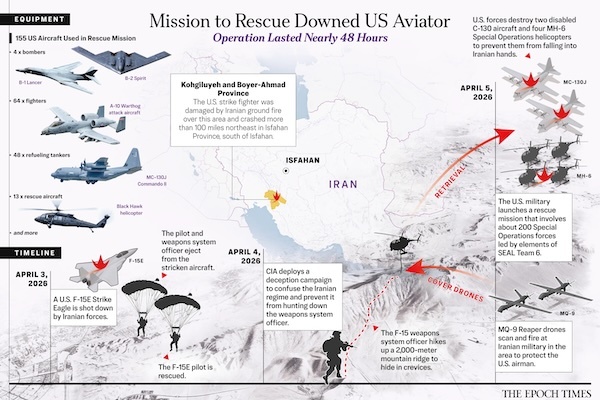
- Here are the details of the complex military operation to rescue a downed U.S. aviator who evaded capture in the Iranian mountains for almost two days.
-
A former architect, Rex Heuermann, pleaded guilty to the murders of seven women around Gilgo Beach, bringing to a close a decades-long string of unsolved killings.
-
In response to a question from The Epoch Times, White House press secretary Karoline Leavitt clarified that President Donald Trump’s comment “Cuba is next” means the communist regime “is bound to fail.”
-
🍵 Video: Your phone is draining your brain, even when it’s off.
|
|
|
President Donald Trump was assured by the Pentagon and Central Intelligence Agency that the assembled array of special forces, precise intelligence, high-tech electronics, and battle-tested aircraft could extract a wounded U.S. airman being hunted deep inside Iran, but was cautioned that it would be risky and could go sideways in a hurry. It was his trigger to pull, they said. His call. “A risky decision,” Trump said. “We could have ended up with 100 dead, as opposed to one or two—a hard decision to make.” But in the end, the choice was clear.
“In the United States military,” the president said, “we leave no American behind. We don’t do it.” During an April 6 White House press conference, Trump recounted how “one of the largest, most complex, most harrowing combat searches ... ever attempted” was orchestrated, serving as a narrator still buzzed by what he had watched unfold as it was happening early on April 5 in Iran. “As commander in chief, I never forget the extraordinary risk taken by the warriors that we send into battle,” he said.
Less than 80 hours earlier, on April 3, an F-15E Strike Eagle had been damaged by ground fire over Kohgiluyeh and Boyer-Ahmad Province and crashed more than 100 miles northeast in Isfahan Province, south of the city of Isfahan, where there was a large Iranian military presence. One man was rescued. One man was missing.
There was now only one mission. First Rescue After more than 13,000-plus U.S. combat sorties over Iran since Feb. 28, a “Golden BB” shot fired by what analysts believe was a visually sighted, shoulder-fired surface-to-air missile found its mark. The F-15, from the 494th Fighter Squadron of the 48th Fighter Wing—the Statue of Liberty Wing—based in RAF Lakenheath in England, was the first U.S. fixed-wing fighter to be knocked from the sky by enemy fire since an A-10 was shot down over Baghdad in April 2003.
Later that same day—on April 3, Good Friday, two days before Easter—an A-10 would be damaged by enemy fire and crash, with the pilot safely ejecting into Kuwait.
The F-15’s pilot and systems weapons officer both safely ejected but were dispersed, one waiting a few seconds after the other in parachuting to earth as trained to do. (More) |
The U.S.-Iran ceasefire has gotten off to a shaky start, with U.S. officials acknowledging the truce is “fragile,” but that talks were progressing. Here are some key points so far: |
-
Iran’s Foreign Minister Seyed Abbas Araghchi said that a two-week ceasefire hinges on halting Israel’s attacks on Hezbollah in Lebanon. Vance said the truce did not include Lebanon, adding that he thinks Iran’s position came from a “legitimate misunderstanding.”
- Israel’s strikes on central Beirut on Wednesday killed 182 people, Lebanon’s health ministry said.
-
Iran’s parliamentary speaker accused the U.S. and Israel of violating three parts of the ceasefire framework. Vance dismissed the claims, saying that “ceasefires are always messy” and that there are still many points of agreement.
-
Iran closed the Strait of Hormuz in response to Israel’s attacks on Lebanon, Iranian state media reported. But White House press secretary Karoline Leavitt disputed the report, saying the United States has seen an uptick in traffic in the Strait.
- Iran has signaled a willingness to hand over its enriched uranium, the White House said.
-
After meeting with NATO Secretary-General Mark Rutte at the White House, Trump reiterated his dissatisfaction with the military alliance. “NATO wasn’t there when we needed them, and they won’t be there if we need them again,” Trump wrote in an all-caps social media post.
-
Following the ceasefire, House and Senate Democrats will move to force votes on war powers resolutions to block military action in Iran without congressional approval. Previous votes on similar measures have failed.
|
- Pam Bondi will no longer appear for a deposition before a House panel probing Jeffrey Epstein, the DOJ said, citing that she is no longer the attorney general. In response, Democrats on the panel threatened to file contempt charges if Bondi doesn’t attend.
-
Health Secretary Robert F. Kennedy Jr. is starting a podcast, “The Secretary Kennedy Podcast,” aimed at exposing “lies that have made us spiritually, morally, and physically sick,” he announced.
-
Nonpartisan election forecaster Cook Political Report shifted five House races in favor of Democrats this midterm, signaling a difficult environment for Republicans defending their narrow House majority.
|
- A federal appeals court temporarily allowed the Pentagon to designate Anthropic as a supply-chain risk after the AI company requested the court to block the move. The ruling appears to conflict with a California district court decision blocking the designation, meaning the Supreme Court may soon get involved in the dispute.
- The California Supreme Court ordered Riverside County Sheriff Chad Bianco to halt his investigation into 2025 election fraud allegations so the judges can review the legal challenges that his probe faces.
-
A woman dubbed the “Ketamine Queen” was sentenced to 15 years behind bars for supplying the drugs that killed actor Matthew Perry.
-
Young people who identified as transgender suffered from worse mental health both before and after meeting with specialists, a new study found.
-
▶️ Video: Steve Bannon secured a Supreme Court win earlier this week. Here’s what it means.
|
Correction: In the April 6 edition of the newsletter, we misstated that the Artemis II astronauts would be the first to see the far side of the moon. The astronauts were the first to see parts of the far side. The Epoch Times regrets the error. |
| Sponsored by NativePath |
|
You may be eating foods experts say can drive inflammation and impact brain health. The good news: it’s not too late to adjust. Start cutting these foods and add smarter morning options.
Quiz: #1 brain food? A: Peanut Butter B: Black Pepper C: Coconut D: Greek Yogurt
|
|
See Answer ➜
|
|
-
Who Controls the Kitchen Controls the Country—by Mollie Engelhart (Read)
- The Great Toilet Paper Shortage—by Jeffrey A. Tucker (Read)
-
The Life of Frédéric Bastiat—by Lawrence W. Reed (Read)
|
Audience members attend the Monte Carlo ATP Masters Series Tournament at the Monte-Carlo Country Club as a 79.9-metre Feadship superyacht 'Faith' owned by Canadian businessman Lawrence Stroll, majority shareholder of British luxury carmaker Aston Martin, is seen in the background, off the coast of Roquebrune-Cap-Martin, south-eastern on April 8, 2026. (Valery Hache/AFP via Getty Images) |
📸 Day in Photos: Journalist Killed in Gaza, Election Campaign in Djibouti, Marco Rubio Meets Mark Rutte (Look)
🎙️ Podcast: Audits Spotlight Unusual Trends in Medicaid Spending for Autism Care—The Report (Listen)
🍿 Film Review: ‘The AI Doc: Or How I Became an Apocaloptimist’ (Read)
|
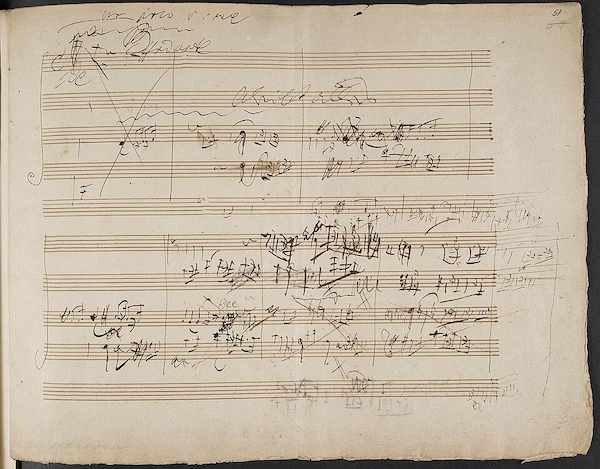
A sketch of what Beethoven considered his most perfect work, his String Quartet No. 14. |
After Ludwig van Beethoven died in 1827, a thorough autopsy confirmed what had long been apparent about his health. His auditory nerves were “shriveled and marrowless,” while the neighboring arteries were “dilated to more than a crow’s quill, and like cartilage.” By then, Beethoven’s hearing loss was unmistakable. He had been completely deaf for almost a decade, following a gradual decline that began as early as 1800.
Beethoven’s deafness remains one of the most compelling topics in music history, as he continued composing masterpieces despite his loss. The Imaginative Conservative website shares an unsent letter known as the Heiligenstadt Testament, where he revealed his inner turmoil. In the throes of despair, he wrote: “I would have ended my life—it was only my art that held me back. ... It seemed to me impossible to leave the world until I had produced all that I felt was within me, as if my art had been entrusted to me by God.”
Beethoven went on to become one of history’s most influential composers. His late works, including the Ninth Symphony and the Missa Solemnis, have come to symbolize the resilience of the human spirit, touching audiences with their emotional depth and profound humanity.
Yet even among these achievements, one work stands out. According to biographer Edmund Morris, Beethoven thought of this piece as “his most perfect single work.”
In published essays, Schumann said it stood on “the extreme boundary upon which all that has hitherto been attained by human art.” Franz Schubert, hearing it for the first time on his deathbed, reportedly asked: “After this, what is there left for us to write?” (More)
|
|
|
Thanks for reading 🙏 Have a wonderful day! |
—Ivan Pentchoukov, Madalina Hubert, and Kenzi Li. |
|
|
Copyright © 2026 The Epoch Times, All rights reserved.
Our mailing address is: The Epoch Times, 129 West 29th Street, Fl 8, New York, NY 10001 | Contact Us
Our Morning Brief newsletter is one of the best ways to catch up with the news. Manage your email preferences here or unsubscribe from Morning Brief here.
*Disclaimer: The opinions expressed in this advertisement are exclusively those of the advertiser and do not represent our views or positions. This material is promotional in nature and should not be mistaken for news, research or editorial content. |
|
|
|