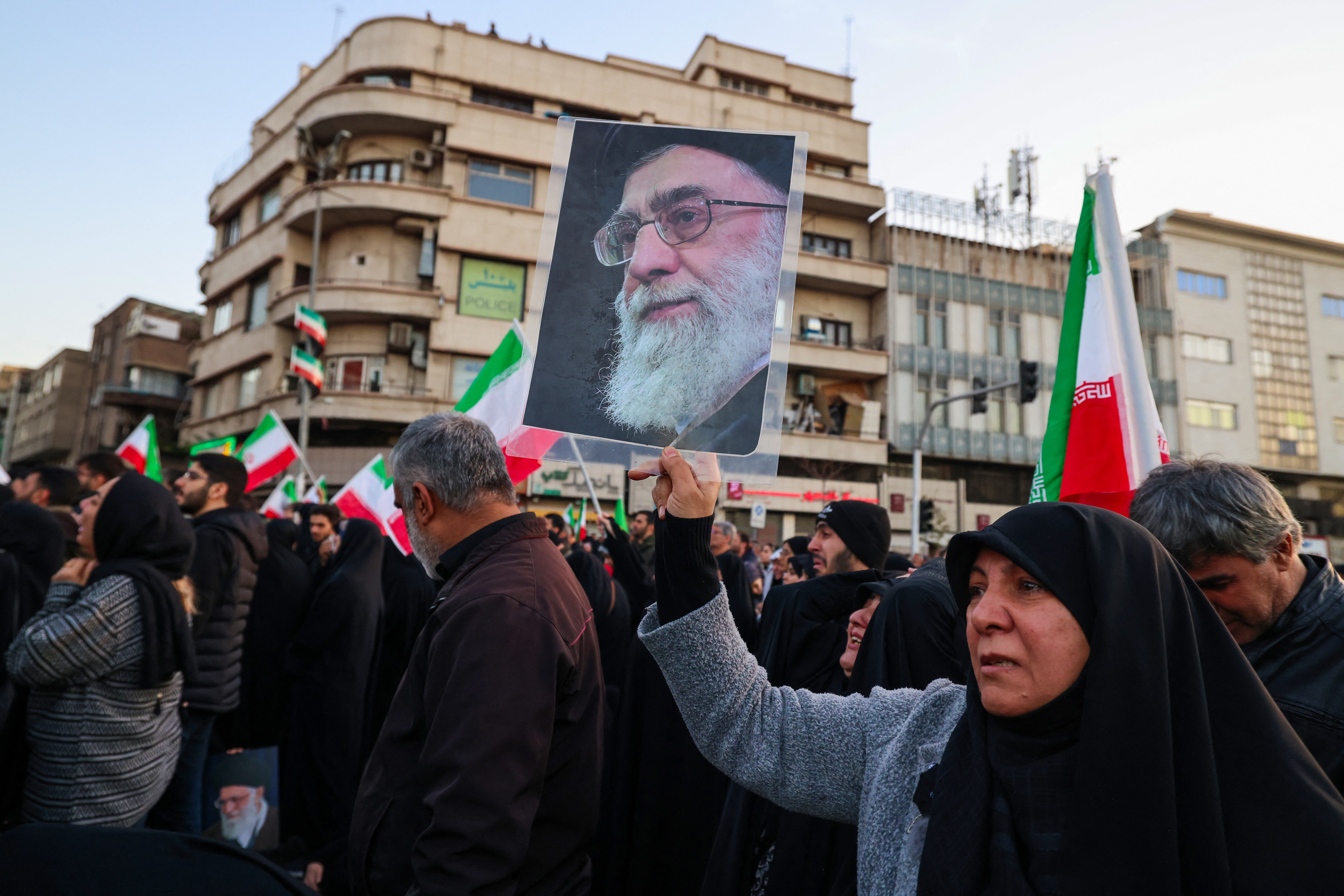
After the death of Ayatollah Ali Khamenei in U.S. and Israeli airstrikes in Tehran, a temporary council has taken over the leadership of the nation.
Iran’s President Masoud Pezeshkian said March 1 that the new leadership council “has begun its work.”
U.S. President Donald Trump has called on the people of Iran to rise up against the regime, explicitly tying U.S. interests in the region to regime change and preventing a nuclear-armed Iran.
The commission taking over control of the nation in the midst of its war against two global superpowers is a short-term stopgap. Ultimately, a new leader will be selected by clerics within the state’s theocratic constitution.
Here’s what to know.
Temporary Leadership Council
Under the process outlined in the nation’s constitution, Iran on Sunday organized a council to assume leadership of the country and carry out the roles previously filled by Khamenei.
Ali Larijani, Secretary of the Supreme National Security Council of Iran, announced the plans to form the council.
Members of the council include Pezeshkian and the head of the nation’s judiciary, Gholamhossein Mohseni-Ejei. The two will step in and “temporarily assume all the duties of leadership.”
Pezeshkian has sought reform during his tenure, though the establishment figure was historically on good terms with Khamenei and the regime. Mohseni-Ejei, meanwhile, is known to be a hardliner on Islamist revolutionary doctrines.
Ayatollah Ali Reza Arafi was selected as a third member of the leadership council. The 66-year-old cleric was picked by Khamenei to serve on the Guardian Council, which helps lead Iran, in 2019.
Clerics Select New Ayatollah
Under the Iranian constitution, a selected slate of the nation’s clerics “must, as soon as possible,” select a new ayatollah to lead the nation.
The 88-member panel delegated the responsibility is known as the Assembly of Experts, and consists entirely of Shiite Muslim clerical leaders.
These figures are popularly elected every eight years, though their candidacy must be approved in advance by the Guardian Council. Around half of the council’s members are chosen by the ayatollah, ensuring the regime’s broad control over the process.
To win election to the office, a candidate must obtain two-thirds of the vote in a secret ballot.
One of the considered contenders for the top job is Khamenei’s 56-year-old son, Mojtaba Khamenei.
High Stakes
The individual selected for the post through the process will have the ultimate say over all matters of governance in the Persian state, giving the figure extreme power over the complicated power-sharing arrangement at the heart of the Shiite Islamic theocracy.
The ayatollah also serves as the chief commander of the nation’s military and the paramilitary Islamic Revolutionary Guard Corps. In 2019, the U.S. designated the latter group—which had been empowered by Khamenei during his reign—as a terror organization.
The process to select a new leader has only been used by the Persian state once before, in the June 4, 1989, election of Khamenei to the post.
Khamenei’s election followed the death the same year of Grand Ayatollah Ruhollah Khomeini. Because of his leading role in the creation of the Islamic Revolutionary state, Khomeini was not elected through the process.
Possible Regime Change
Khamenei’s long 37-year tenure as leader of the nation means that the process hasn’t been used since his election.
This time, it would come amid the backdrop of a major bombing campaign by the United States and Israel, who have openly called on the Iranian people to overthrow the regime.
Trump said Khamenei’s death was “the greatest chance for the Iranian people to take back their country.” He urged Iran’s Revolutionary Guard and policy to work with the people to rebuild the nation.
Iranian leaders seemed determined to maintain the current system of government, with the president vowing revenge and the vice president ordering officials to ensure administrative functions were uninterrupted. Still, the regime’s future seemed unclear, particularly as U.S. and Israeli forces target high-ranking officials.
Israeli Prime Minister Benjamin Netanyahu said in a post in the Persian language on X that Israel plans to “strike thousands of targets of the terrorist regime … in the coming days.”