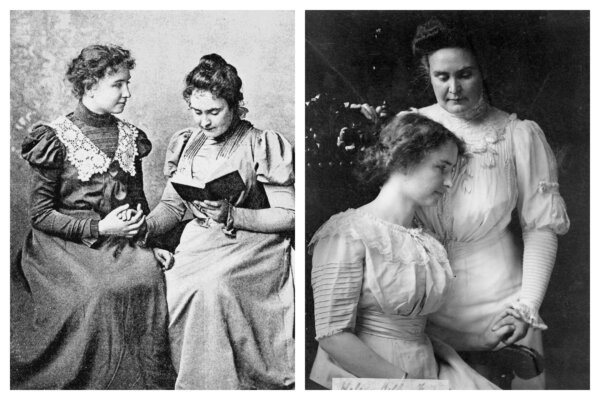
| On April 5, 1887, Anne Sullivan (1866–1936) wrote a letter to Sophia Hopkins, her friend and patron, about a breakthrough event that had occurred that morning:
“We went out to the pump-house, and I made Helen hold her mug under the spout while I pumped. As the cold water gushed forth, filling the mug, I spelled ‘w-a-t-e-r’ in Helen’s free hand. The word coming so close upon the sensation of cold water rushing over her hand seemed to startle her. She dropped the mug and stood as one transfixed. A new light came into her face. She spelled water several times.”
The following day, Sullivan added this postscript: “Helen got up this morning like a radiant fairy. She has flitted from object to object, asking the name of everything and kissing me for very gladness. Last night when I got in bed, she stole into my arms of her own accord and kissed me for the first time, and I thought my heart would burst, so full was it of joy.”
So Sullivan recorded the famous incident that later appeared in Helen Keller’s autobiography, that key moment when a 6-year-old deaf and blind girl had her life transformed by her teacher.
Anne Sullivan is a fascinating example of the many influences that go into the building of character. Her harrowing younger years of abuse, pain, and loss; the education, love, and refinement she received during her Perkins schooling; and the faith in her abilities shown by her teachers—all of these shaped the young woman who was given charge of Helen Keller.
|