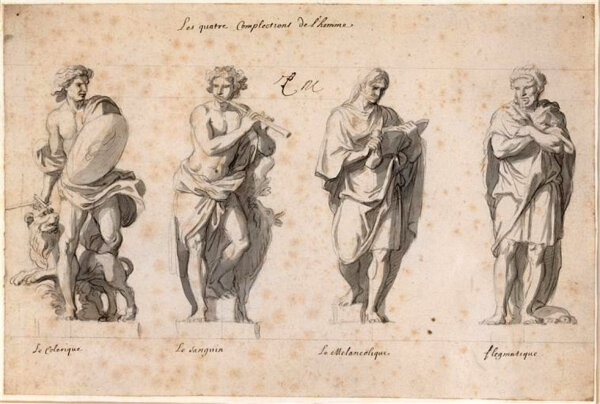
| Most of us are familiar with the Myers-Briggs personality test and other contemporary personality tests, but there’s a much older temperament classification model that often gets neglected: the classical four temperaments.
This model originated with Hippocrates 2,000 years ago and was further developed in the Middle Ages. Despite its antiquity, it continues to serve as an excellent key for understanding both oneself and others. Knowledge of temperaments can help us identify and counteract our weaknesses while capitalizing on our strengths. It also enables us to better understand—and get along with—others in our homes, communities, and workplaces.
In his book on the medieval worldview, “The Discarded Image,” C.S. Lewis explained the theory behind the four temperaments. The ancient and medieval conception of the human body saw it as a combination of four fluids or humors that reflected the four elements: hot and moist make blood, hot and dry make choler, cold and moist make phlegm, and cold and dry make melancholy (sometimes tied to bile).
As Lewis explained, “The proportion in which the Humours are blended differs from one man to another and constitutes his complexion or temperamentum, his combination of the mixture.”
It’s this variable mixture that gives rise to a person’s personality, according to medieval theory. Generally, one humor predominates, giving the person his or her overall temperament: sanguine, choleric, phlegmatic, or melancholic.
Although the physiological side of the four humors is obviously flawed, the classification of temperaments that derives from this theory remains strikingly accurate. Anyone who comes to understand the four temperaments will immediately recognize in each type the features of real people that he knows. He may also discover insights about his own nature, explanations for characteristics that used to puzzle him.
|