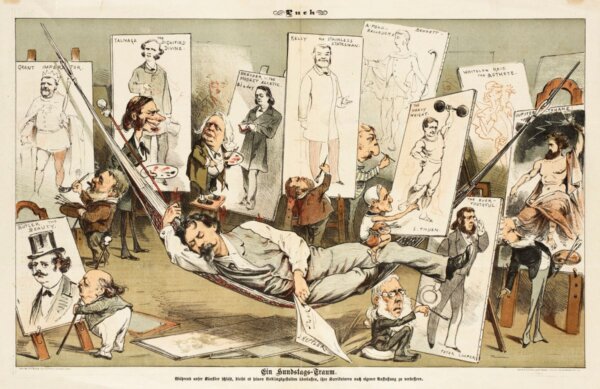
| Joseph Keppler’s story is one of persistence and reinvention. The son of a politically exiled baker, Keppler trained as an artist in Vienna but found early attempts at a stable career elusive. From painting and theater work to failed publishing ventures, his path was marked by false starts—until he discovered the medium that would define him.
After immigrating to the United States in the late 1860s, Keppler (1838–1894) gradually carved out a place in the competitive world of illustrated journalism. His early German-language humor magazines faltered, but they laid the groundwork for a more ambitious vision. That vision took shape in Puck, a satirical publication that would become one of the most influential voices in American media. Blending humor with incisive political critique, the magazine captured the attention of a rapidly changing nation.
Keppler’s cartoons stood out not only for their artistry but also for their substance. With wit and precision, he tackled political corruption, corporate power, and social tensions of the Gilded Age. His work resonated widely, helping to shape public opinion and, at times, influence political outcomes. One of his most famous images, depicting powerful industrial interests looming over the Senate, distilled his contemporaries' growing anxieties about monopoly and governance into a single, unforgettable scene.
Keppler’s legacy isn't without complexity. His cartoons sometimes reflected the biases and controversies of his era, even as they challenged others. Through success, rivalry, and personal loss, he remained committed to his craft, mentoring a generation of artists and expanding the reach of illustrated commentary.
In skilled hands, satire can illuminate the forces shaping a nation, and leave an imprint that endures long after the ink has dried.
|